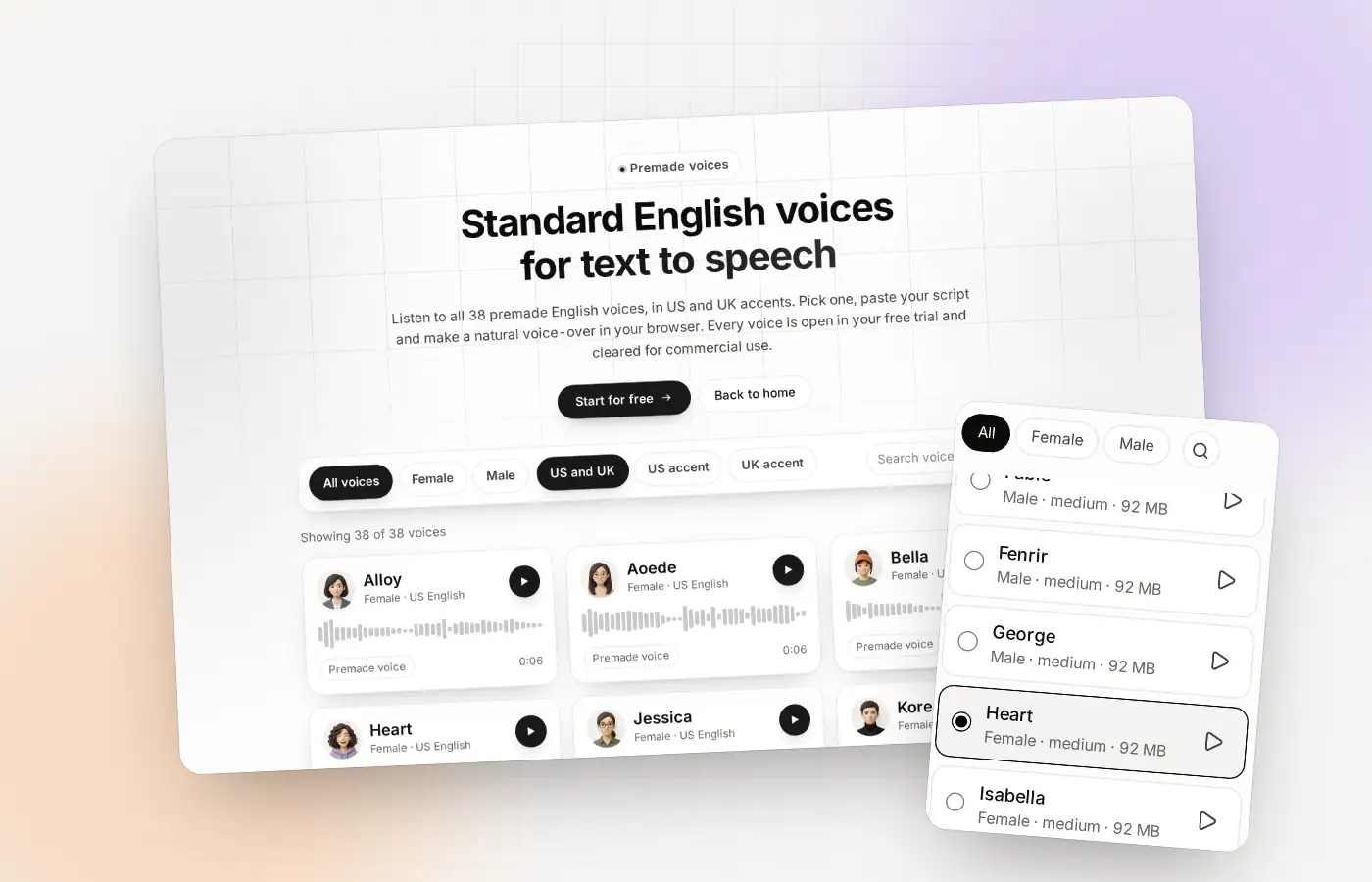
Commercial use at a glance
| Standard voices | Offered only if the licence allows commercial use |
|---|---|
| Credits | Some licences require crediting the dataset authors, listed on the Voice licences page |
| Free plan | Credit “Made with Clonylab” when you share the voice-overs |
| Pro and Team | No Clonylab credit line |
| Cloned voices | Your own voice or a voice with the speaker’s clear, lawful permission. You are responsible for the use |
| Voice models | Open-source: Kokoro (Apache-2.0) and Piper (MIT) |
| Not legal advice | Check your own case, especially for ads, broadcast or resale |
What “commercial use” means here
Commercial use means using the audio in something that earns money or supports a business. A YouTube channel with ads, a course you sell, an advert for a client, a product demo, a podcast with sponsors. All of those count.
Clonylab’s Voice licences page says it directly: we only offer voices whose licence allows commercial use. Some licences ask you to credit the people who built the voice data, and those credits are listed on the same page. We do not claim ownership of the voice models.
| Project | Standard voices | What to check |
|---|---|---|
| YouTube video with ads | Allowed | Credit if the voice licence requires it |
| Course or training you sell | Allowed | Credit if required, and keep a note of the voice name |
| Advert for a client | Allowed | Tell your client the voice is generated |
| Podcast with sponsors | Allowed | Say that the intro is generated if listeners could be misled |
| Reselling the audio as a voice product | Check the licence and the Terms | Ask us first |
Credits you may need to give
There are two kinds of credit, and they are different.
- Clonylab’s credit, on the free plan. When you share a voice-over made on the Trial plan, you credit “Made with Clonylab”. Pro and Team do not have that line.
- Dataset credits, for some voices. A few voices were trained on data whose licence asks for attribution (for example the SIWIS and Koniwa audio inside Kokoro, under CC BY). The Voice licences page lists the exact text for any voice that needs it.
If you are not sure whether a credit applies to the voice you picked, read the list on the Voice licences page and add it when it does. Adding a credit that you did not need costs you nothing.
What the voices are built on
Clonylab’s standard voices run on two open-source voice engines. Knowing them helps if a client asks where the voice comes from.
| Component | Used for | Licence |
|---|---|---|
| Kokoro-82M by hexgrad | 28 named US and UK voices | Apache-2.0, including some audio under CC BY |
| Piper by Rhasspy and the Open Home Foundation | 10 neutral voices | MIT |
| espeak-ng | Turning text into speech sounds | GPL-3.0, with source available |
| onnxruntime-web and transformers.js | Running the models in your browser | MIT and Apache-2.0 |
The full list is on the Voice licences page. If you need a statement for a client, point them there.
Cloned voices are a different question
A cloned voice is not one of our standard voices. It comes from a recording you provide, so the question is who the voice belongs to. The rule is simple. Clone only your own voice, or a voice whose speaker has clearly and lawfully allowed you to. You confirm that before every clone.
If you clone a client’s or a colleague’s voice, get their permission in writing and say what it covers: the project, the time and where the audio will be used. The Terms forbid using a cloned voice to impersonate anyone, to deceive people or to pass generated speech off as a real recording. What you make with a cloned voice is your responsibility.
Which plan for commercial work
| Free | Pro | Team | |
|---|---|---|---|
| Standard voices for business use | Yes | Yes | Yes |
| Clonylab credit when you share | Required | Not needed | Not needed |
| Characters | 300, one time | Unlimited | Unlimited |
| Good for | Trying a project | Regular client work | A small studio or team |
For a client job, you will likely want unlimited characters, so Pro or Team. See unlimited text to speech and text to speech for teams.
A note on legal advice
This page explains how Clonylab works. It is not legal advice, and it cannot cover every country or every kind of project. If you plan to use a voice in broadcast, in a regulated industry or in a product you resell, ask your own adviser. You can also write to us with a specific question.
A checklist before you publish commercially
Run through this list for each project. It takes two minutes and avoids most problems.
- Which voice did you use? Note the name, such as “Heart” or “Cori (high)”.
- Does its licence ask for a credit? Check the Voice licences page and add the credit if it does.
- Which plan were you on? On the free plan, credit “Made with Clonylab” when you share.
- Is the voice a clone? If it is, confirm that it is your own voice or that you have the speaker’s permission.
- Could listeners be misled? If so, say that the voice is generated.
- Does your client or platform have rules? Some platforms and clients have their own rules about synthetic voices.
What clients ask, and what to answer
| Client question | A straight answer |
|---|---|
| Is this a real person? | No. It is a generated voice from an open-source model |
| Are we allowed to use it in our advert? | Clonylab only offers voices whose licence allows commercial use. Share the Voice licences page |
| Where does our script go? | Nowhere. It is processed in the browser and is not uploaded to Clonylab |
| Can you match our spokesperson’s voice? | Only with that person’s clear, lawful permission, and a clone made by you from their recording |
| Can we get a WAV for our editor? | Yes, you can download MP3 or WAV |
How to say a voice is generated
Being open is good practice, and in some places and on some platforms it may be required. A short line is enough. Choose wording that fits your project.
| Where | Example line |
|---|---|
| A video description | Voice-over generated with Clonylab. |
| A podcast intro note | This intro was read by a generated voice. |
| A course page | Lesson narration is generated from the scripts. |
| A client delivery note | Voice: generated, standard English voice. Licence details on request. |
Records worth keeping for each project
| Record | Why |
|---|---|
| The voice name and the date you made the audio | So you can show which voice and licence applied |
| The plan you were on | It decides whether the Clonylab credit applies |
| For a clone: the speaker’s written permission | Proof that the voice use was agreed |
| The final script | In case a client asks what was said |
None of this is hard, and all of it protects you and your client.
Where to go next
- Read each licence on the Voice licences page.
- Compare plans on the pricing page.
- Ask us a question on the contact page.
Questions about commercial use
Can I use Clonylab voices for commercial projects?
Yes. Clonylab only offers standard voices whose licence allows commercial use. Check the Voice licences page for any credit a voice requires.
Do I need to credit Clonylab?
On the free Trial plan, yes: credit “Made with Clonylab” when you share the voice-overs. Pro and Team do not have that line.
Do I need to credit the voice creators?
Only where a voice’s licence requires it. Those credits are listed on the Voice licences page.
Can I use a cloned voice commercially?
Only if it is your own voice or you have the speaker’s clear, lawful permission. You are responsible for how you use it.
Can I use the audio on YouTube or in ads?
Yes for standard voices, within the licence. Credit where required, and be open that the voice is generated if listeners could be misled.
Do I own the audio I make?
We do not claim ownership of the voice models or of what you generate. Read the Terms for the full wording, and ask your own adviser for your case.
Is this legal advice?
No. It describes how Clonylab works. Ask your own adviser about broadcast, regulated industries or resale.
Can I use a voice in a client’s advert?
Yes for standard voices, within their licences. Tell your client the voice is generated, and keep a note of the voice name and date.
Do I need permission to clone a client’s voice?
Yes. Get the speaker’s clear, lawful permission in writing and say what it covers. You confirm this before every clone.
Where do I find the licence for a voice?
On the Voice licences page, which lists the credits some voices require and the open-source components behind them.
Make a voice-over for your project
Pick a standard voice and hear your script. Free to start, no card needed.
Sources and further reading
- Apache License 2.0 · The full text of the licence the voice model is released under.
- Kokoro-82M model card (Hugging Face) · The voice model Clonylab’s standard voices run on, with its Apache 2.0 licence.
Written and checked by the Clonylab team. Last updated . The screenshots were taken from the Clonylab app on that date. Read how we work on the About page, or contact us if something on this page is wrong. See also the Terms, Privacy policy and Voice licences.